It’s been several months, but the Peripheral Manuscripts Project is online!
It’s actually been up for nearly a year as we methodically add content, one collection at a time. As of today, we have nearly 300 works from 18 collections representing 17 partner institutions available for exploring. We are still processing metadata from Truman State University’s Pickler Memorial Library Special Collections, University of Dayton’s Special Collections and Marian Library Special Collections, University of Saint Mary of the Lake, and Indiana University Lilly Library. We aim to have the remaining collections published by spring of 2026.
We have opted for a soft launch rather than a splashy one until we are able to publish all the collections. We ran into some technical challenges rooted in how to best approach the metadata modeling for complex manuscript descriptions that are appropriate for a more generalized digital library repository discovery environment.1 Also, this project is expansive! It relies on a diverse group of partners who collaborated to streamline a distributed digitization and description workflow for medieval manuscripts across the midwestern United States. This work entails multi-step, iterative quality review processes for digitization and manuscript description.2
These collections are complex; comprised of materials from the 9th to 16th centuries in various formats: fragments, binding fragments, codices and documents that include treatises and papal bulls. To accurately capture all these complexities, the project team uses OCHRE: An Online Cultural and Historical Research Environment, which supports the creation of multi-layered hierarchical metadata and relationships that exist between entities. OCHRE allows the project team to provide multiple levels of description for the container, the works within the container, their constituent parts, and how the works may relate to other works.
From Canonical to Derivative Metadata
To help visualize this process, we will step-through the metadata and modeling process using Xavier University Library’s St. John Chrysostom, Quod nemo leditur and Sermons (XAU_007): https://purl.dlib.indiana.edu/iudl/peripheralmss/XAU/XAU_007_001.
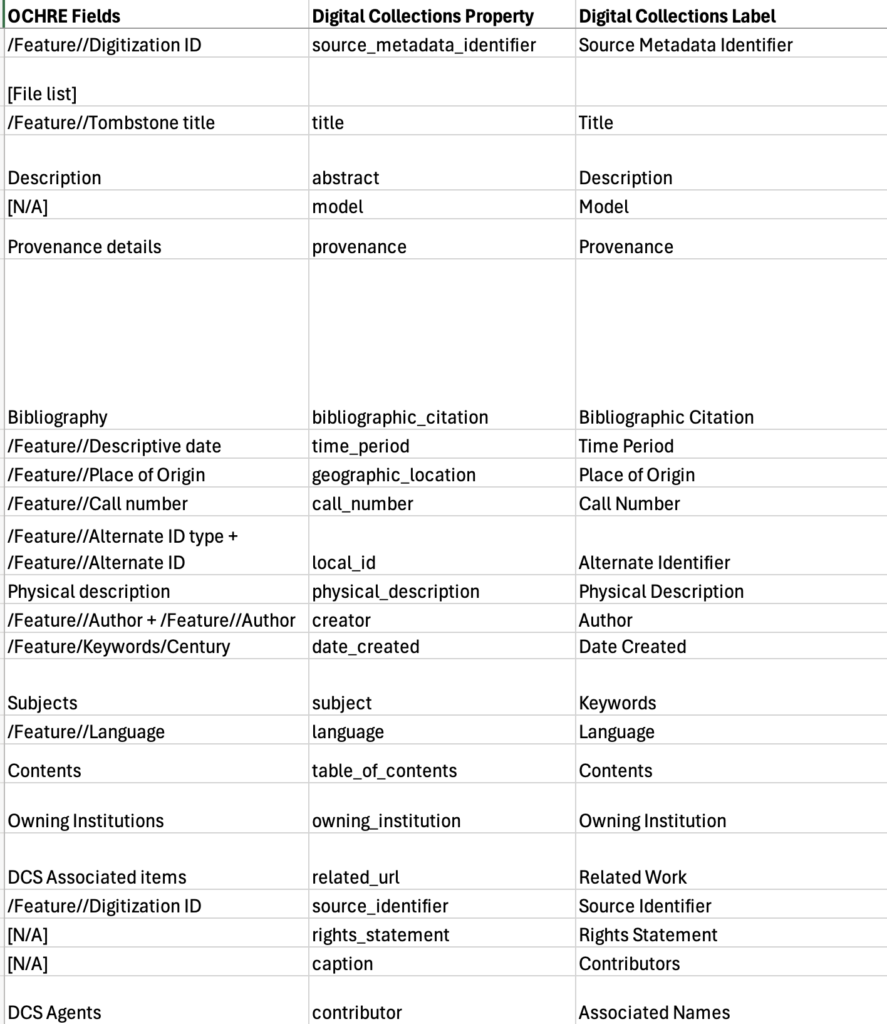
OCHRE serves as the canonical source for metadata researched and compiled for the project, while the digital library repository used to make these collections discoverable, Digital Collections, requires a flatter, though not necessarily less robust, derivation of the metadata. The first step in the metadata modeling process was to map the OCHRE metadata fields to the metadata properties supported by Digital Collections (see figure 1). We had upward of 50 metadata fields from OCHRE to map to approximately 25 fields for Digital Collections.
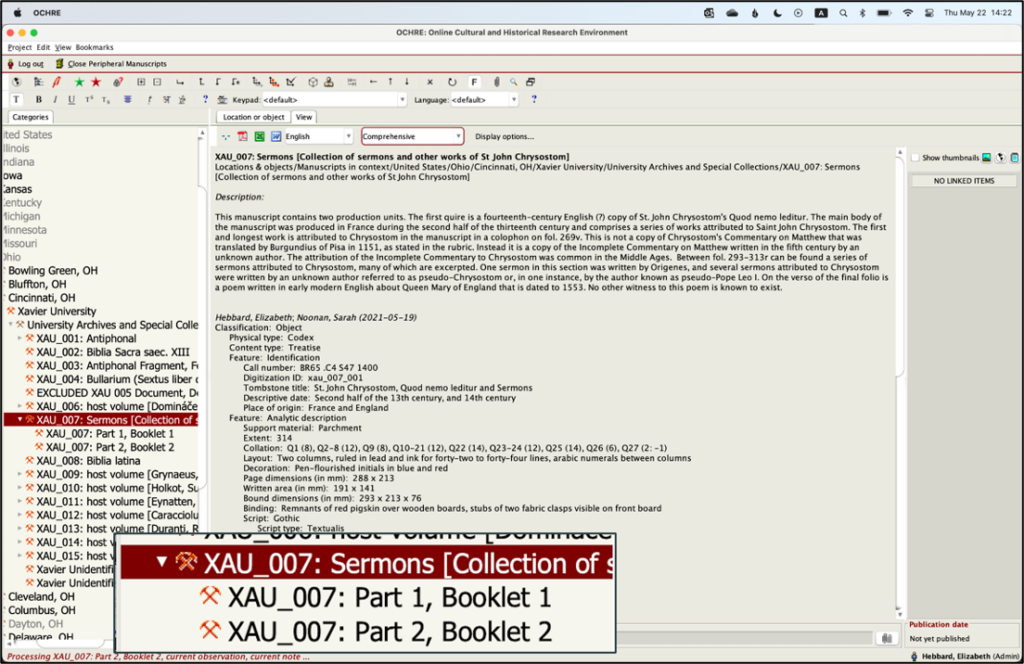
In Figure 2, we have a glimpse of how XAU_007 is represented in OCHRE. The work contains two parts with descriptive metadata at the work- and part-levels.3 Because OCHRE is based on a graph database model, the OCHRE CSV export required customization to get the preliminary flattening of the metadata records.
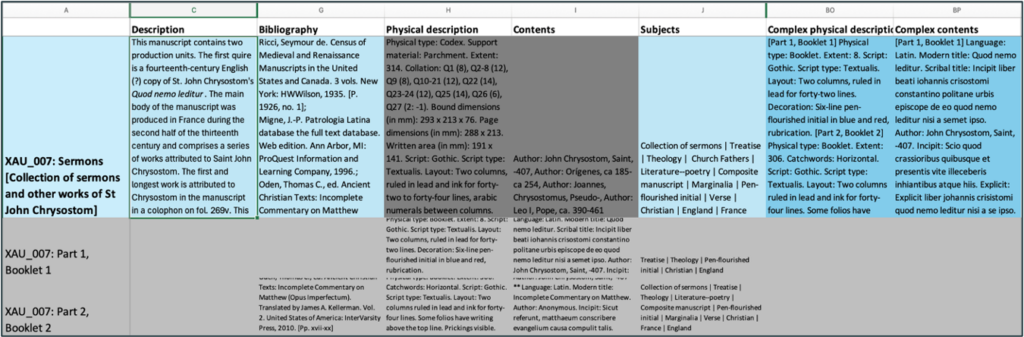
The CSV export as seen in Figure 3 reflects this preliminary flattening as a row of descriptive metadata for the work as a whole and a row of descriptive metadata for each of the parts (booklets 1 & 2).
Based on the final metadata mapping (figure 1), we iterated through several versions to arrive at the ultimate flattening of the OCHRE output that works for the Digital Collections repository; we needed to squish three rows of metadata into one row for Digital Collections without losing any of richness.
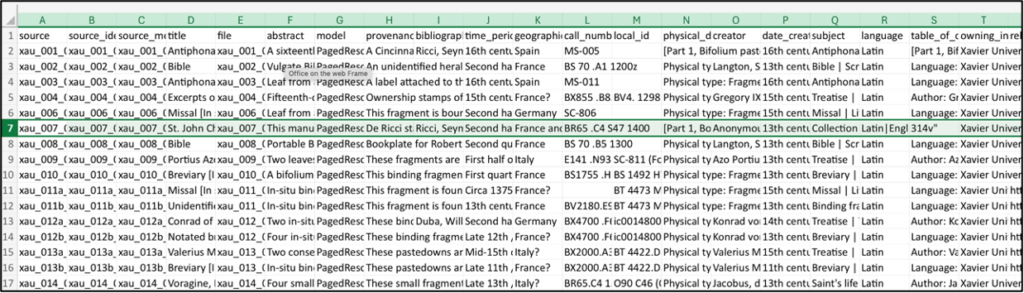
Figure 4 demonstrates how we collapsed two parts of this work highlighted in gray and combined them with the parent record highlighted in blue (see figure 3). This required extensive data wrangling, including deduplication, field concatenation, and condensing multi-directional linking of related manuscripts into bi-directional linking for Digital Collections.
Representing Medieval Manuscripts in Digital Collections
Ta da! Here you can see how we went from various iterations of the canonical and serviced metadata along with the corresponding image file groupings to represent this codex in the Digital Collections repository (figure 5).
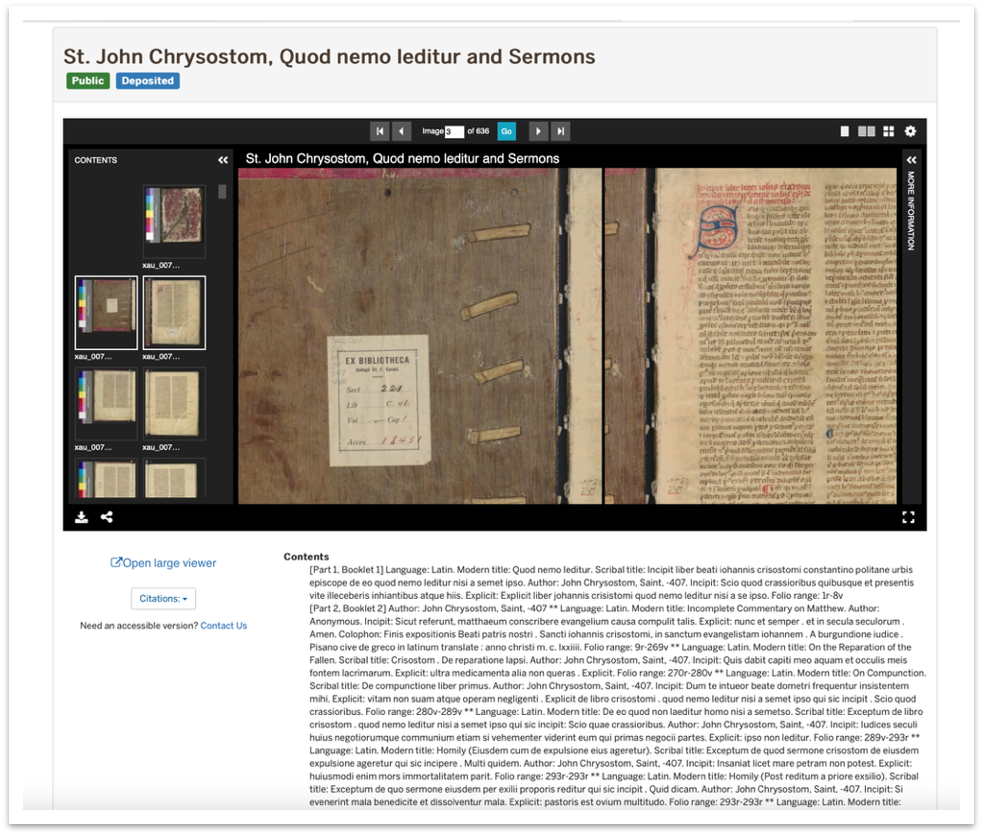
In the case of codices, especially complex codices with multiple parts, the metadata is dense and the display is tricky to manage due to formatting limitations in Digital Collections. It is also currently not possible to clearly reflect where parts begin and end in a codex in the “Contents” section of the image viewer. Despite the compromises and concessions we made to integrate these materials into a general-purpose digital library repository, the project team settled on a metadata model that will expose these collections without diminishing their potential for discovery.
We still have some work to do to improve the interactions with the manuscripts. As you explore, if you encounter any issues, please email the project team with a description of the problem and a link.
Happy exploring!
Notes
[1] For geeky highlights about some of these technical challenges, see: Dalmau, M., Hardesty, J. and Anand, S. (2025) “Conundrums of Open Repositories: Challenges in Establishing a Collaborative Framework for Digitizing Medieval Manuscript Collections Across the Midwestern United States”. Open Repositories 2025 (OR2025), Zenodo, 17 June. https://doi.org/10.5281/zenodo.15758612.
[2] Dalmau, Michelle, Sarah Noonan, and Elizabeth Hebbard. “Overcoming Silences in the Archive: Establishing a Collaborative Digitization Framework for Medieval Manuscript Collections Across the Midwestern United States”. Presented at the Digital Humanities 2025 (DH 2025), Lisbon, Portugal, July 16, 2025.https://doi.org/10.5281/zenodo.17106570.
[3] For the purposes of this blog post, I am over-simplifying the metadata workflow. We hope to publish a more extensive piece about the project’s approach to metadata at a later date.


